quick thyme first aid

Abrasions, light scrapes and grazes are perhaps the most common injuries from which gardeners suffer; they include those surface layer wounds that often you don’t notice at the point of occurrence but may smart or sting later in the day – a scraped knuckle, a lightly skint knee, a scratch along your arm from a thorn or a cane, an incidence of friction between skin and wall or other abrading surface.  Most abrasions will heal quickly and without scaring or complication, once cleaned and kept clean for a few days post incident.  Generally resolving within a week but abrasions like any laceration or wound, if not treated promptly and properly may become contaminated by dirt or dust particles and are liable to septic infection and a spectrum of bacterial infections also.

A first-degree abrasion involves superficial damage to the epidermal layer of skin, bleeding is minimal if present at all.

First response: Washing the site with soapy water to remove any debris and following up with antiseptic wipe, liquid dap, iodine or ointment application is the traditional approach. Slight stinging may arise in the process of cleaning and sterilizing.

Garden Aid; Upon rinsing of the wound with clean hose water or supplying a lick of naturally antiseptic saliva, the garden offers an array of natural antiseptics that are quickly utilized – A rub of crushed or torn calendula petals or a smear of Aloe vera gel will clean and seal over the wound from potential secondary infection.

Sustained remedy – if the abrasion was from a less than desirable surface or source then an infusion of thyme is an excellent wound healer with instant antiseptic and antimicrobial properties. The trick is in its thymol content, which is similar in antimicrobial potential to carbolic acid and as effective as iodine or phenol based antiseptics.

TRY THIS AT HOME -Thyme antiseptic rinse

Thyme infusions and oil of thyme have an ancient linage in healing, back to the Egyptians and the origins of medicinal botany but before the discovery of antibiotics, doctors once soaked bandages in thyme to disinfect the cloth, to kill germs on the surface of wounds and help activate the healing of wounds. The active antibiotic principle in thyme, thymol is considered to be 25 times as effective as phenol (the active ingredient in over the counter antiseptics).

Ingredients:

  • 1 bunch Thyme (several sprigs) or      2tbspoons dried herb
  • 1 cup water

Method: As you would make a herbal tea – Garden grown thyme can simply be harvested, torn or crushed to open a pathway to the volatile oils and phytochemicals within, then added to boiling water, steeped for a few minutes, before straining and cooling to yield a soothing wound rinse.

Intended for immediate use but will store in refrigerator for several days. Suitable to also remedy cough, sore throat, cold and flu, headaches as an herbal tea or topically applied to cuts, infected wounds, athlete’s foot and yeast infections.

Note: Adding some lavender or rosemary herb to the mix will boost the disinfecting properties of this rinse.

Posted in Herbal Remedy Recipes | Tagged , , | Leave a comment

Naked solstice after sun remedies

Bheannacht ar an lá – blessings of the day.

Today, the solstice, when more than the earths axis tilts towards the sun. Maybe you are naked in a dance to manifest abundance or maybe you are just catching the few extra rays that today provides. Note – The shade of a tree in full leaf can provide sun protection to the tune of 10 to 20 SPF but you will need more than that to shield your skin.

So just in case the sun more than kisses.. try the following aftersun remedies-

  • Aloe Vera. The fresh sap cools the burn, lessens the reddening and triggers skin regeneration.
  • Baking soda. It helps to balance your skins pH and speed recovery/healing. Add about a ¼ cup baking soda to a lukewarm bath and take a sunburn-healing soak.
  • Black tea. The tannins reduce inflammation and promote healing, don’t blame me if they also provide a fake tan.  Make tea, cool leaf or bag and rest on worst affected areas or have a bath with some tea added and some iced tea sipped.
  • Cucumber. A chilled puree will remedy sunburn if aloe vera is not to hand. Chilled slices if you fear the gunk.
  • Lavender bath or essential oil. Lavender foliage and flowers in a bath or topically applied essential oil is fresh and cooling but can also prevent peeling.
  • Natural Yogurt. Cooling agent but also like baking soda works to sort the pH of skin and trigger faster healing with Natural enzymes that speed sunburn recovery.
  • Potato peels or grated raw potato. A cooling layer  with much needed moisture and some anti-bacterial and anti-inflammatory properties also.
  • Vinegar.  Not for the chips you will make when you start peeling potatoes but  dilute in one part water to one part vinegar as a chilled skin spritz to lessen the red and the heat sensation and bring a healing pH to skin. Plain white or apple-cider, both do the magic.
Posted in Gardeners Health | Tagged , , , , , | Leave a comment

gardener’s first aid for allergic contact dermatitis

Allergic contact dermatitis is an allergic reaction to a substance, material or plant that you have come into contact with; it generally manifests post contact as a region of itchy inflamed skin situated where contact had taken place. In severe instances and were scratching is not abated the site can develop sores. In some instance prolonged rashing and autoeczematisation can occur. In most scenarios ACD reactions disappear within days but the reaction potential persists indefinitely.

The delayed reaction can hinder deduction of the triggering allergen which will need avoidance or removal if possible from the garden context.  The symptoms of ACD or any active dermatitis are mostly treated with emollient creams. Often ACD sufferers are prescribed topical steroids and Topical or oral antibiotics for any secondary infection arising. In severe cases oral steroids or immunosuppressive medications are employed.

First response:  Wash with clean water to remove any residue allergen, follow with a lavender or rosemary herbal rinse to lessen irritation and swelling and to ward off any secondary infection via their antimicrobial activity.  Apply Aloe Vera gel or strawberry pulp to cool and soothe the flared skin or a cooled Mugwort (Artemisia Vulgaris) infusion if particularly itchy. Allow irritated skin to breathe for a day, if not beginning to subside thereafter, or if this is not the first time an ACD incident  occurred then commence longer term treatment.

For longer term treatment: Make and apply a calendula and chickweed emollient or salve. Calendula (Calendula Officinalis) renowned for its skin healing abilities actually stimulates cellular regeneration, coupled with its anti-inflammatory, antifungal, antibacterial and antiseptic properties it address both initial flare up and potential secondary infection. Chickweed (Stellaria Media) is a weed with a purpose and actually soothes rashes and skin irritations via its natural anti-inflammatory and demulcent properties.

Posted in Gardeners Health | Tagged , , , , | Leave a comment

The saturday night show discusses holistic gardening

see for your self http://www.rte.ie/player/ie/show/10153449/

Posted in Gardeners Health | Tagged , , , , , | Leave a comment

The edible edible invasive

So good I named it twice…

Carpobrotus edulis or Cape fig, originally from the cape territories of South Africa was introduced to many territories around the world as an ornamental garden plant, beautiful and useful (fire-retardant, erosion control, medicinal and edible) but ultimately a garden escapee than can run amok in the wild… But one that we can help control with our knife and fork.

As many know and as many may guess ‘edulis’ means edible but Carpobrotus, if we didn’t already know or guess, reminds us further that this plant is comestible –   karpos, from the Greek means fruit, and brotos, also Greek – means edible. It is not related to figs or the Moraceae family, but it’s fruit is somewhat fig-like in shape and texture hence the many common names referencing fig.

And like figs, its fruit is wonderful cooked into  a curry and also in chutney. And like figs can find their way into a salad or a pickle. The fresh fruits can be a be a bit too mucilaginous  and astringent from some tastes while to others the juice is prized- simply wait for the  flower to die off then pick the receptacle and  squeeze the often very sweet juice straight into your mouth. A sugar rush for your tongue.

If you let it ripen well before harvesting, then the fruit takes on a stronger, salty and sour taste and  also it drys and cooks well too upon maturity.. and remember that you are removing its self-seeding potential in this manner, so stopping some further spread. Leaves are also utilized in culinary and medicinal applications too.

How to ID it –  Carpobrotus edulis  is a  robust, carpeting and trailing succulent perennial. It roots at nodes and at the growing point it sends out horizontal stems in an upwards curve. The foliage is sharply 3-angled and when sliced is triangular in cross-section. Its solitary, flowers are 100-150 mm in diameter and  yellow in colour to begin but fade to pale pink. The fruit is fleshy and indehiscent, approximately 35 mm in diameter, somewhat fig-shaped, becoming yellow and more fragrant as it ripens, wrinkling with age It can flower at different times in different territories but it is blooming when summer comes.

Nice images to help idhttp://thehorticult.com/the-community-garden/carpobrotus-edulis-sour-fig-highway-ice-plant-pigface-hottentot-fig/

If you have a nice recipe for cape fig or any other invasive — do share!

Posted in Food fixes | Tagged , | Leave a comment

Dye Invader Dye!!

How about we harvest out the invasive species for their craft and industry potential. Some have good woods for turning but many yield dyes to get fashion-minded heads turning.

A rose-tinted dye is reputedly obtained from the bark of those weed trees – sycamore..  and other invasive acers can yield brown and black tones from foliage and twigs.

Playing with mordants  and boil times will yield good results if you are up for the experiment.

Buddleia davidii  yields a range of dyes; An orange-gold  that deepens to brown dye is obtained from the flowers while Black and dark greens can be manufactured from  twigs, stems, foliage and flowers.

Cotoneaster microphyllus and other garden escapees of the cotoneaster variety yield a rose to tan dye via their fruit.

A yellow to saffron-tinged dye is obtained from the flowers of crocosmia spp

A black dye can be  obtained from the wood of Fuchsia magellanica  while the flowers yeild in the range of red and purple.

The roots of Gunnera tinctoria and other species of Chilean rhubarb contains around 9% tannin and yield black dye

The stems of   Himalayan Balsam (Impatiens glandulifera) yield a  yellow dye.

The foliage Rhododendron ponticum  with an alum mordant offers golden tones or alternatively with  a copper or iron mordant will yield browns.

A yellow dye can be obtained from the fruit  and also the roots of sea buckthorn (Hippophae rhamnoides),  while a blackish-brown dye comes from the younger foliage and shoots of the same plant.

Gathering plant material for dyeing: foliage and twigs can be harvested at any stage of development, Blossoms should be in full bloom and berries should be ripe  – but you can play around and be pleasantly surprised by experimentation.

To make a dye solution: Chop up the gathered plant material into small pieces then place in a pot (large enough to immerse your fabric), add enough water to double the amount plant material. Bring to a qick boil, then let simmer for around an hour.  You can let sit overnight for deeper colours or Strain away plant parts straight away and add the treated fabric to the dye solution. The longer you soak the stronger the potential colour.

To treat fabric pre solution dyeing: to help the colour set – the rule is to soak your fabric in a colour fixative before the dye process begins.

Pre-dye Fixatives:  Salt works well for or berry dyes – mix a 1/2 cup of table or sea salt to 8 cups cold water.  for dyes plant of other plant parts try  1 part vinegar to 4 parts cold water. Professional Dyers utilize other active ingredients as fixers/mordants.

Mordants:  A mordant which  literally means “to bite” is a chemical fixative that not only improves lightfastness but can alter then tonal range of the dye. A different mordant with the same plant dye can yield dramatic difference, even the opposing end of the colour wheel. Mordants can be a hydroxide of aluminum or chromium or other mineral or chemical agent. To learn more about mordants visit – http://www.earthues.com/aboutmordants.html

Caution: Wear gloves to handle any fabric that has been dyed you don’t want to be caught red handed for a whole week. Also  some plant dyes and mordants can be sensitising or even toxic/irritant. Do not inhale mordant powders.

Posted in Plant profiles | Tagged , , , , | 2 Comments

Alien attack… Invasive plant species and how to deal with them. Part 3

Previously I blogged about gunnera spreading along canals and streams… well another riverbank monster is Himalayan balsam (Impatiens glandulifera)… But while the trend is to bash it, it has some good edible applications; The peppery seeds are wonderful in salads and baked on breads. From the same family as busy lizzies this very busy plant escaped from gardens to naturalise in the wild. Towering sometimes to 3 meters, its seed capsules explode with tremendous force and fling their shot as far as 7 meters from the parent. They form dense stands and crowd everything else out. Rapid along riverbanks and canals, streams, ponds and lake margins and any dampish hill, they die away completely in winter and leave the surface soil open to erosion which in many instances causes sediment to be deposited into waterways, burning up tax revenues on clearance and detrimentally affecting fish spawning.

The Himalayan plant is everywhere nowadays, easily recognisable by its purplish–pink to pale pink flowers that bloom abundantly from  June to August in the shape of a English police helmet (attested to by one of its common names), and at other times by their translucent, fleshy stems. They bear large pointed leaves, ovalish, edged with obvious teeth each one with a small globular ‘gland’.  So floriferous that they do steal all the bees.  Often reducing the native populations by 25% in a given year, achieved by detracting from native pollination. So floriferous that seed falls to the ground at a recorded density of between 5000 – 6000 seeds per square meter of surface soil. Prolific is the word.  Herbicide is effective at home. Wild colonies are subject to balsam bashing days by local conservation groups; this entails whipping the plants with sticks before they flower or set seed – if in seed you are only spreading the populations. Repeated cutting back will help eradicate.

Giant hogweed (Heracleum mantegazzianum) is far from edible,  in fact it would blister your mouth to a hospitalization degree. A taller (3-5m) and more robust cousin of hogweed and cow parsley, it is phototoxic; meaning its juice will burn your skin in daylight. So hogweed bashing or even strimming is not an option. The lesions the plant cause are slow to heal and what is known as post-inflammatory hyper-pigmentation can persist for as long as 6 years after initial contact with the sap. The giant hogweed also contains  furanocoumarins which are detrimental to birdlife and is a danger to pets.

This biennial plant was introduced from south west Asia in the 19th century, intended as as an ornamental garden plant. Today it is more commonly found in escaped colonies along river banks, road sides and waste ground, occasionally along walkways and park paths, triggering closure of the amenity until the spread is removed. Denser colonies exist in damper places and riverbanks are most prone to rapid invasion. Typical with the invasive aliens it excludes indigenous herbaceous plants, and ultimately undermines riverbank stability. It is a major nuisance in disaffecting salmon spawning. Typical too with the most successful invasive it produces several thousand seeds per plant, which are light enough to travel good distances on a breeze and even further on water currents. The flower is typical of umbellifers, looking like the spokes of an upside down umbrella clustered with a frenzy of tiny white inflorescences. It flowers between June and September. The stem has distinct purple blotches and is both hollow and ridged. It smells a little like parsnip and in fact its rootstock is quite like a bloated parsnip. To get rid of it off your land, wear protective clothing especially goggles and gloves, it can be dug up and if not bearing seed, dried and composted. It is susceptible to repeated herbicide applications. It may take a few goes but persistence will win the day. Of all on the list this is the most dangerous one and needs tackling straight away. Protect children and pets for exposure to it.

Lastly but by no means least we come to Hyacinthoides hispanica, better known as the Spanish bluebell.  This perhaps is the toughest in the list to think of as an alien invader, worthy of extraction from the garden and wild. But don’t be fooled by its blue-eyed good looks. It’s a thug.   In many respects it is considered a more steroid version of a native bluebell, but beyond its vigor if you look closely, all of its bell flowers  are arranged around the stem. Natives hang their bells to one side. This a key clue as the Spanish hybridize readily with the natives and the natives take on that trait amongst others.

The Spanish entered Ireland via garden centers, sold as an ornamental and this is evident in their colour varieties, not just blue but pink and white. The problem is that the Spanish out compete the natives and lure away pollinators while simultaneous hybridizing native populations out of existence.  Seed dispersal of both original and hybrid is largely by wind and generally over short distances so its threat is currently not considered high, but we have an opportunity to not let it escape further into wild native colonies by not planting Spanish or hybrids in our gardens and insisting garden centers trade in native stocks only.  If you have non-native bluebells in your garden, dig them up, crush the bulbs, dry out the mashed bulb and compost or dispose sensibly. The problem is that they are a risk, they will alter ecology..  so no matter how ornamental remember ‘potential detrimental’.

So they may not have come from outer space, but all that means is that we can’t kill them off with the common cold. We need a strategy. Governments and conservation groups around the world are continually revising methods of control. The best control is self control, I know that means different things to different people but in this case it means don’t plant an invasive species in your garden and if you have one or two already there then it is up to your self to control it.  And if you really want to play a bigger part, your local conservation group are always on the lookout for volunteers.

Meantime KEEP WATCHING THE SKIES!!!

Just in case.

Posted in Plant profiles | Tagged , , | Leave a comment

Alien attack… Invasive plant species and how to deal with them. Part 2

So we are under attack, what is our response?

Well if you are enlisting then the first rule of war is to know your enemy and I will equip you (within the posts on invasives) with all you need to know to identify and tackle the  most troublesome species that threaten your garden and your environment today.

The term ‘Alien’ applies to non-native species, predominantly ones that have escaped their confines as a garden ornamental or their original indented function as a fodder grain and is now naturalising in the wild. There are many, hundreds, in tiny pockets, and many have no adverse impacts, they add nectar to the food chain and keep pollinators energized and will not spread beyond the laneway of the garden they escaped from but occasionally a non-native-species naturalises with nectar so abundant that bees neglect to visit the natives and thus risk of population extinctions exist. So your laneway of Spanish bluebells or willowherb dominates and seasonality and successive flowering species disappear from your patch, displacing pollinators and butterflies and the birds that feed upon them. Then one day you realise songbirds no longer wake you in the mornings. That’s what I mean by insidious. A slow death to diversity. A loss, slow but ultimate.

In other instances the alien plants are so competitive, spreading by root runners and simultaneous catapults of seed clusters that they overrun all the available surface ground and deny the natives a chance to reproduce, smothering out parent generation in the process and becoming the sole species in operation very hastily. It is these invasive that are the biggest threat, because there effect is quickest felt and hardest to reverse. The lane was yesterday, the hedgerow to the next county is today, tomorrow is higher taxes and local authority rates to deal with the menace, or worse spoilt water courses, closed amenity paths and ‘postcards from Ireland’ with a quaint cottage and a giant Chilean rhubarb or expanse of crocosmia where a hay field or birch grove should be. The shocking thing is that those postcards exist already. Our heritage beauty spots are daubed over with fuchsia, gunnera, crocosmia and rhododendrons. We are losing our botanical and ecological wealth.  

You will be familiar with rhododendrons. If you don’t have one in your garden already then you would have admired one in a local park or in the grounds of the last golf course, spa or hotel that you visited. These profuse flowering evergreen shrubs where introduced to Ireland in the 18th century, to do the very job that they are doing today, to be an attractive garden and landscape specimen. There are many beautiful varieties in many wonderful colours of flower but one, an attractive purple flowering variety, called Rhododendron ponticum turned out to be a fatal attraction.  It is the variety which annually and globally causes fatalities and near death experiences via what is known as mad honey syndrome; the toxic nectar it offers leads to poisoning of local honey supplies. It was this mad honey that halted Xenophon and his Greek army in their tracks and later destroyed Pompey and his roman troops when they encountered it. It is this honey that was man’s early biological warfare. It has that potential today, to ruin a honey harvest, to intoxicate bees, and to poison animals as its browsed foliage is rich also in grayanotoxin. The recognizable flowers have a small calyx with 5 blunt teeth and a lilac coloured bell-shaped corolla often with a pinkish or deeper purplish tinge. The throats of these flowers hold green-yellow spots.

In its war, this enemy secretes allelopathic toxins to salt the earth as it where and thus blight the regeneration of native plants. It forms a strong defense by growing as impenetrable thickets which cast so deep a shade that germinating light cannot get to beleaguered natives. Its establishment here was quick, having been extensively planted as game covert and demesne ornamental but its ability to regenerated rapidly after cutting, fire  and even herbicide application is matched by the enormity of wind dispersed seed that it produces annually, as much as 3-7000 per individual inflorescence. Talk about the invading hordes.  It also suckers and can root from uncleared cut branches or broken branches touching the ground. Now here is the b-movie poster: “it will not die!!!”

Ponticum leaves are long and oval, dark green above and paler beneath, approximately 10-20cm long and 2-6cm wide with a leathery or waxy texture that allows herbicide to run off and potentially enter water courses. So manual cutting and stem injecting is the current method of checking. I say ‘checking’ as that seems to be as far as it gets, eradication may take a few human generations per plant population. Unfortunately Rhododendron also acts as a host for Phythopthora ramorum a serious plant disease also known as Sudden Oak Death and of all place to impact in Ireland it struck first in Derry city, the city named after the Irish word for oak. While in County Kerry, both native Arbutus and oak woods are collapsing under the forceful colonisation tactics of Rhododendron. Elsewhere it is working its way. 

It is so costly to tackle rhodo infestations but perhaps the toxic attributes of the plant could tackle rodent infestations and the plant be harvested commercially for such, the proceeds helping to continue with its own eradication. Local authorities and enterprise boards might take note. Meantime if you are stuck with a stand of rhodos that you need to rid before they block out the last blade of grass in your lawn, then the best tactic is continual hard cutting to undermine the vigour, and then if possible dig out roots. Caution on burning stumps and branches as the smoke will also contain some minute toxins. Allow to dry, shred if possible. Persistence will be needed and so might fresh soil to the eradicated site. Make sure it is fresh.

Soil is one of the major vectors of spread for invasive species. Japanese knotweed (Fallopia japonica) especially so.  Only female plants occur in Ireland so seed is not the issue, rather it the case of extensive rhizomes which can profit to excess of 3 metres depth and extend to stretches of 7 metres laterally from a parent plant. The tiniest sliver of root is viable to produce a new parent. It was first introduced into Ireland as an herbaceous perennial for ornamental value back in the middle of the nineteenth century and it would make attractive foliage foil to any exotic or cottage border with its large foliage which is broadly oval and pointed in an arrow heart manner and bearing of a pale stripe down the middle, where it not for the fact that it outcompetes so vigorously and is so resistant to digging out or herbicide applications. Its whitish flowers are held in loose and slender panicles; they arise from the leaf axils and are a magnet to bees. Easily identified by its hollow square stems and pink new growth flushes.

Since its arrival it has escaped from gardens and parks to establish monocultures along roadsides, waste ground and river banks. In many ways it is ecologically damaging, the roots being quite penetrative and undermining to foundations and paved surfaces but it is river bank colonization that displaces indigenous root systems that prevent soil erosion, that causes most concern. A native of Japan, it is an edible delicacy there and this fact may provide a clue to checking its spread or at least making it a functional addition to our fauna. Road side harvesting is ill advised due to exhaust fumes and riverbank populations may have been chemically treated but if it rampages through your borders, why not try it steamed with some butter. Why not eat it to extinction or better still imbibe it away.

The wonder drug or uber-nutrient of recent years is Resveratrol. That miracle ingredient found in red wine, red grapes, cranberries and blueberries. That natural gift that lengthens life, fights cancer, and stimulates the SIRT1 gene. That is the gene responsible for reducing fat stores during lower calorie diets and also the key gene being studied to slow down the aging process.  Well guess what. Knotweed has it in abundance.  In China, Korea and Japan a beverage called Itadori Tea (the foliage of knotweed) is a traditional remedy for heart disease and stroke. Mildly laxative but detoxing. Again, is there a potential industry in the control of this invasive plant?

The counter attack may be more fruitful than we currently imagine.
Posted in Plant profiles | Tagged , , , , , | Leave a comment

Alien attack… Invasive plant species and how to deal with them. part 1.

What is an alien species? You may well ask. It is not something that has crash-landed here from outer space or even from 1950’s Hollywood, although in some respects one could find similarities (and I have used that analogy in my Bloom 2013 garden to highlight the crisis http://www.bloominthepark.com). Rather these aliens are essentially non-native species that have been introduced to our island, sometimes intentionally, other times unintentionally, from other regions of the world. Once established into our indigenous ecosystems they commence to either outright run amok our slowly, insidiously, begin quietly displacing the original native inhabitants. So they are not a good thing. That said when I write words such as ‘insidious’ or ‘running amok’ I get a slight cringe of am I being extreme, these words in other contexts have been utilized by xenophobics and genocidists to justify hate and evil deeds. One can’t hate these invasive species, especially the botanical invasives which this article focuses on. In fact one must marvel at their tenacity and capacity to stay alive, propagate and thrive, by some amazing evolutionary tactics. The problem is that all that is at the expense of so many other species. These aliens are in reality on the attack. Colonizing with blitzkrieg efficiency and ruthless old roman decimation of pre-existing flora and fauna from the new territory they gain every day.

The ‘invasion of the body snatchers’ hysteria surrounding them is often justified as they can displace not just local populations of native plants but the insects, birds and animals linked to those plants. It is not just habitat destruction but food chain disruption that makes them a serious ecological threat. They are the plant equivalents of the grey squirrel, cruel and ruthless beneath the cute appearance. Not only are they making devastating inroads but their impact will be long felt. Some can change soil ph., some can transmit diseases to crops and forests and some can even poison livestock and foraging animals and pets. All can change the landscape of your childhood in a manner that would render your descriptions alien to your children’s grandchildren if we don’t try and reverse their gains, if not eradicate them fully from our shores. They will still thrive in their native places of origin so that task is not extermination off the face of the planet.  This is more like weeding on a grand scale than it is hunting to extinction. There is not an ethical dilemma to face as such and no dodos will get hurt in the making of this article or your responding to it.

There are arguments that this is simply survival of the fittest and we are just in the midst of evolution at play. Well oak woods and native bluebells are hardly lumbering dinosaurs and their replacements of rhododendron and Spanish bluebell are hardly cattle and gazelles.. as in are hardly the most functional, productive or beautiful. A native oak will support a plethora of wildlife not just as a winter food source for red squirrels, pigs, deer and jays but during spring and summer it acts as an enormous food supply as its foodchain is webbed out from the hosting of 284 associated insect species. Think of the birds that survive off that. Think of the fox that harriers your chickens because the woods have a scarcity of birds. The knock-on is enormous. Oak foliage is fodder to numerous and its decaying matter feeds the soil and boosts fertility of the district it grows in. on the other hand, non-native rhododendrons are invading and outcompeting oak woodlands. These replacements have toxic leaves and offer no sustenance to herbivores and so decrease local carnivore species, the insects that can tolerate the toxins are not natural to Ireland and so its lack of support to naturally occurring species of insect and bird is effectively collapsing  food chains and foodwebs in their wake. The falling leaves of rhodos acidify soil and lower fertility, even pollute waterways. This is not an evolutionary leap forward. No more than cancer is evolving humans. Strong words… but it is easy to do nothing as if the will of the universe or god is at play. Man introduced these species. Man must take responsibility. Like it or not the invasion is happening on your watch.

Posted in Plant profiles | Tagged , | Leave a comment

Rhod rides roughshod over Biodiversity

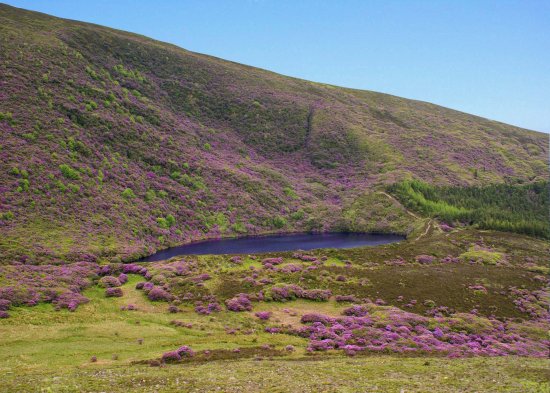
KONICA MINOLTA DIGITAL CAMERA

Rhododendron ponticum  invades three habitats that are considered internationally important under the Habitats Directive: upland oak woods, bogs and heath.

An individual Rhododendron ponticum  casts  such deep shade that it light-starves out existing native plant colonies at its base.  Insult to injury – It also  secretes allelopathic toxins which retard germination and regeneration of native plant species nearby.

Given that rhododendrons have a tendency to forms stands and dense thickets the problem of indigenous flora displacement is compounded.

The plant impacts adversely on local fauna too –  by displacement of  their usual food supply and altering of natural habitat cover. Furthermore the foliage and tissues of Rhododendron ponticum contains quite high concentrations of  toxic phenols, which are deadly if ingested by browsing wildlife and other herbivores.

Rhododendron ponticum is also host to the plant fungus Phytophthora ramorum which is the causative agent of “Sudden Oak Death”.  It may be beautiful in flower and there is the Darwin argument but really it is time to look at reversing its spread and well tolled damage.

Traditional methods of control can be viewed at http://www.killarneynationalpark.ie/Rhododendron.htm

http://www.issg.org/database/species/reference_files/rhopon/rhopon_man.pdf

http://invasivespeciesireland.com/wp-content/uploads/2012/01/Rhododendron-BPM.pdf

Untraditional methods – future uses

http://www.wildresources.co.uk/reports/rhodo_eng.pdf

http://www.pfaf.org/user/Plant.aspx?LatinName=Rhododendron+ponticum

http://mapping.fbb.utm.my/phyknome/node/17208

see more in this blogs invasive species counterattack category

Posted in Plant profiles | Tagged , , | Leave a comment